In our latest class we explored Hatsumi Sensei's idea of 技掛け変え waza kake kae. Soke entered in very casually, just resting his arms in the jūmonji position.


In our latest class we explored Hatsumi Sensei's idea of 技掛け変え waza kake kae. Soke entered in very casually, just resting his arms in the jūmonji position.

I began class with 風盂 Fūu. Muto dori that borders on mystical. But I shared a trick I learned recently from Soke to use your shako ken like totoku.
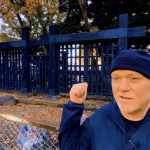
This morning I went into Tokyo to visit the 黒門 kuromon, or black gate. This was one of the few structures from 寛永寺 Kan'ei-ji that survived the battle of Ueno

Bujinkan video exploring the kata 桝骨 Masubone. As the opponent cuts in, you evade while controlling his forearm. I learned this from Hatsumi Sensei as a strong grip on the radial bone. This grip can pull, pry, or lever the bone itself to control the opponent. This is what the name of the kata alludes to, manipulating the frame of the opponent.

We shifted to Mawashi Dori. Three sharp strikes topple the opponent with the sword. Each is precise to take apart the structure of the attack and disarm.
Bujinkan training in Japan isn't only about training. Sometimes it is about cultural experiences you might have there. And sometimes you might even find healing in the dojo!

My Bujinkan video exploring the idea of 雰囲気 Fun'iki. A place can have a mood or an atmosphere, but so can a fight. Hatsumi Sensei advises us to harness these moods to change the outcome of a fight.

My Bujinkan video exploring 浮舟の構 Uki bune no kamae. The appearance of this kamae is virtually identical to 一之構 ichi no kamae but with a different emphasis. Instead of shielding, the kamae has an adaptive, floating quality.

My Bujinkan video exploring the strategy of 出離の棒 Shutsuri No Bō. During the last few years when Hatsumi Sensei was actively training, he did mutō dori against the Bō in almost every class. He told us this idea of shutsuri as a way to detach and be free of the attack from the Bō.