We harness the attitude of heiki while exploring the Bujinkan kata, Shitō. The attacker applies a choke which can cause panic. Staying calm, cool, and...


We harness the attitude of heiki while exploring the Bujinkan kata, Shitō. The attacker applies a choke which can cause panic. Staying calm, cool, and...

I began class with 掛倒 Ketō. I was fortunate to study this in Japan a couple of weeks ago with more than one instructor. Nagato Sensei did a nice interpretation.

I began this day by catching a train to the Bujinkan Honbu Dojo for a class with Furuta Sensei. In the past few years I’ve been able to train with him quite a bit. And each class gives me a little more insight into the gokui of 雲隠流 Kumogakure Ryū and Ninjutsu.

My Bujinkan video exploring the kata 鼯飛 Gohi and 撇飛 Hetsubi. Normally I only work on one kata per class, but these two are very similar. In both cases, you leap and and ambush the opponent with a clawing attack before knocking them down.

My Bujinkan video of the kata 抒投 Yokutō. We warmed up with 当身の鍛錬 Atemi No Tanren striking and conditioning drills. We began by using cross steps from 右正眼 Migi Seigan. Then the warmup evolved into two and three punch combos using reverses and leaps.

Bujinkan training in Japan isn't only about training. Sometimes it is about cultural experiences you might have there. And sometimes you might even find healing in the dojo!

My Bujinkan video of the kata 神剪 Shinsen. The name suggests pruning kami. But it can also be mind shearing. That makes sense with the attack to the ears followed by a headbutt which will definitely interrupt an opponent’s thoughts.
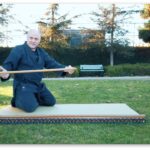
my Bujinkan Kuden covering 体変 Taihen Timing and Distance. We began by throwing shuriken to warmup. Our partner receives from 刀匿礮姿 Tōtoku Hyōshi.

For example, for the kata 飛鳥 Hichō, Hatsumi Sensei added the parenthetical note (飛蝶). It is also pronounced Hichō, but has a different meaning. It means flying butterfly, but more specifically the citrus swallowtail butterfly, Papilio xuthus.